Who Built This and Why
Why Wirebump Exists
I had a high-end router that couldn’t do traffic shaping or VPN without tanking performance. The router even warned me that traffic shaping was not supported above 300 Mbps. Its VPN clients also topped out around a few hundred Mbps. And nobody seems to think you’d want both performance and privacy at the same time.
I threw together some scripts on a Linux box. Within 30 minutes, I had a load-balanced pair of VPN connections working. If I wanted “functional,” I could have stopped there.
But the babysitting is what pushed me to build something better.
VPN servers get overloaded. Endpoints go offline. Sometimes an entire city cluster performs poorly for a while. Every time it happened, I was SSH-ing into a box during a busy workday, manually killing connections, downloading new config files, uploading them, restarting services. Sometimes this happened during a video call. And here’s the thing: if your colleagues can’t make smooth video calls on your VPN solution, it’s not going to last.
In that moment, you have two bad choices:
- Fight your own setup while everyone waits
- Disable the VPN “for now” to get the call back on track
Everyone knows what happens with option #2. “For now” becomes the default when you’re busy or tired.
I was tempted to throw my privacy goals out the window. But I’m a builder.
The early scripts got me something functional in minutes. The next hundreds of hours were about making it livable and workable. One-click redeploy. Hot swaps that don’t drop the LAN. Circuits I could rebuild mid-call with only a slight stutter. A rescue button that bypasses VPN entirely when I need to isolate a problem.
The proof, for me, is boring: my router’s uptime graph is green now.
Business Model
There isn’t one. Wirebump is personal software that I’m sharing for free. It’s not monetized. I built it because the existing options didn’t give me what I wanted, and maintaining a complex hand-rolled setup felt unmaintainable.
Wirebump collects zero telemetry and makes no network connections except to your configured VPN providers. No analytics, no phone-home, no tracking.
Wirebump LLC exists to handle the legal and administrative side of distributing software. It’s a formality, not a startup. I’m not building toward an acquisition or a subscription model.
About Me
I’ve been building and operating enterprise internet infrastructure for over 20 years. I co-founded Fraudmarc, a cybersecurity firm focused on email security.
In 2018, Fraudmarc open sourced our DMARC processing platform, commoditizing what had been a costly industry. DHS immediately adopted it to process aggregate reports from federal agency domains under BOD 18-01, which mandated DMARC enforcement government-wide. Here’s the announcement from when we made DMARC reporting free.
Along the way, I’ve contributed to the Xen Project, operated N2 Servers (a high-availability hosting platform), built llm-router, and created address.pub for secure email receiving.
I’m @kcolemangt if you want to get in touch.
What’s Next
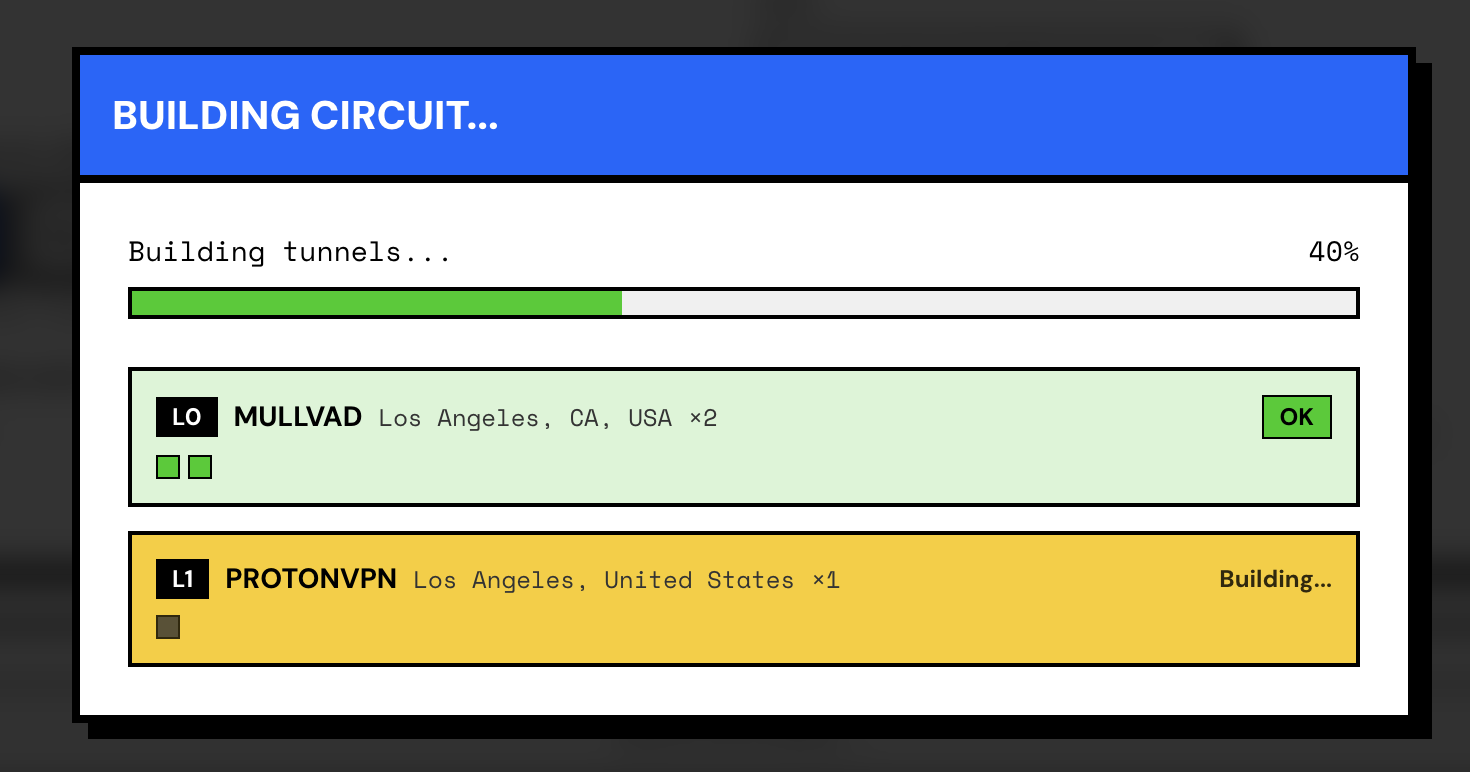
Wirebump already does something I haven’t seen anywhere else: it makes running traffic through multiple VPN providers genuinely easy. You can have Proton and Mullvad tunnels running simultaneously, load-balanced, with zero-downtime switching between them. That used to require serious networking knowledge. Now it’s a few clicks.
Once you have that capability, interesting questions emerge. Right now I’m exploring what happens when you think about traffic patterns - not just encryption, but the timing and shape of your traffic. Even encrypted data reveals information through patterns: when you send data, how much, how often. That’s what researchers call traffic analysis.
Mullvad’s DAITA is one approach to this problem - adding decoy traffic to obscure patterns. But there’s potentially more you could do when traffic is already split across multiple providers, with coordination at the routing layer.
I’m working to understand the problem well enough to know what “better” would look like.
Read the trust model to understand what Wirebump can see and what it can’t.
Try it on a live USB to test without committing to anything.